Introducing Institutional Knowledge


Don Muir & Emre Kazdagli
There is a question we hear in almost every conversation with private markets investors: "How do I make sure the knowledge my team builds on one deal actually carries forward to the next?"
It is a deceptively simple question. And the honest answer, for most firms, is that they don't. When a senior analyst leaves, their pattern recognition walks out the door. When a new deal comes in that resembles something the firm evaluated three years ago, nobody remembers the details. The IC memo is buried in a shared drive. The model is on a former associate's laptop. The risk factors that killed the deal live in the memory of a partner who may no longer be in the room.
This is the trapped knowledge problem. Every firm with a decade of deal history is sitting on an enormous latent asset, built from thousands of hours of diligence, structuring, and investment judgment. That asset is unique to each firm, and explains why two firms looking at the same deal can reach different conclusions. But that asset is also fragmented across file storage platforms, email inboxes, and individual memory. It is not organized in a way that lets investors across offices and strategies seamlessly bring forward the most relevant details the firm already knows. And it depreciates with every departure, every reorganization, every year that passes.
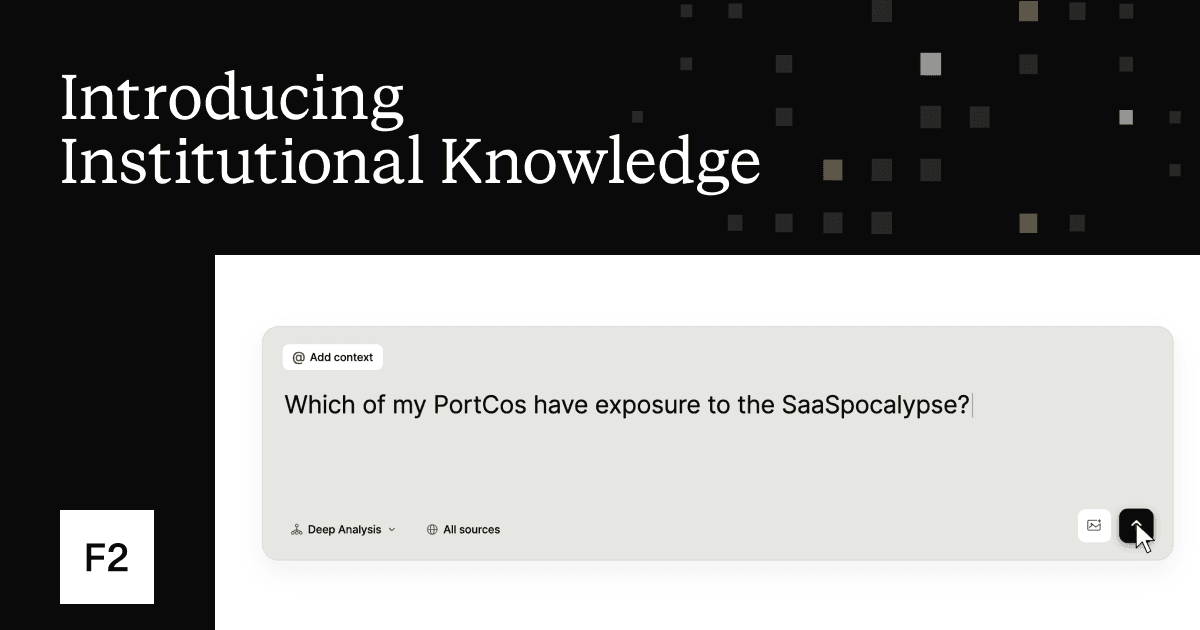
Today, we are launching Institutional Knowledge, a new product within F2 that turns your firm's deal history into a persistent, queryable intelligence layer.
This post walks through what we built, why, and how it works.
The Core Idea
The real opportunity for AI in private markets isn’t speeding up and automating workflows. It is enabling better decisions through compounding intelligence.
Most AI tools in our space are ephemeral by design. You upload a document, ask a question, get an answer, and the context disappears when you close the tab. That interaction pattern treats every deal as isolated, every question as net new. It mirrors the way a junior analyst with zero firm context would operate.
We built F2 differently. From day one, the platform has stored structured data at the deal level: extracted metrics, financial models, memos, risk assessments, and the full analytical context. That persistence is what makes Institutional Knowledge possible. We did not bolt on a memory layer after the fact; the architecture was designed for this from the start.
With IK, deal-level data compounds into a firm-wide intelligence layer. Deals you passed on, deals you executed, and portfolio companies all flow into a centralized, structured library that any team member can query, benchmark against, and reference during live underwriting.
The result: your analysts get the pattern recognition of your most experienced MD. Your MDs get the throughput of a larger team. Your firm stops relearning the same lessons.
The Flywheel
This design enables something no other platform in private markets offers: a self-reinforcing knowledge flywheel.
Phase 1 - Institutional Jumpstart. During onboarding, we ingest your firm's historical deal library: IC memos, financial models, CIMs, CRM data, and any other relevant information. The platform structures all of it into a taxonomy and set of metrics tailored to the firm’s portfolio. The result is a queryable library of every deal the firm has ever evaluated, available on day one.
Phase 2 - Live Enrichment. As your team runs new deals through F2's Deal Intelligence module, the structured outputs (models, memos, extracted metrics) are stored with full context. When a deal is decisioned, it flows into the Institutional Knowledge library automatically. No manual data entry. No maintenance.
Phase 3 - Compounding Returns. The library makes every subsequent evaluation faster and more informed. Each new deal adds context. Each query benefits from a larger base of precedent. The library grows with every transaction, and the value of each query grows with the library.
This is what separates a platform from a tool. Tools deliver linear returns: each task takes the same effort regardless of history. A compounding platform delivers increasing returns: the more you use it, the more valuable it becomes.
What Teams Actually Do With It
Precedent Comp Analysis. An MD evaluating a new software credit asks F2 to pull every software deal the firm has seen in the last five years with total net leverage above 5.0x. Within minutes: a structured comp table with entry leverage, pricing, EBITDA margins, ARR growth, and outcomes, every metric traceable to its source document. Work that previously took an associate two days happens before the first call with the sponsor.
Risk Pattern Recognition. A deal team underwriting a healthcare services platform queries IK for historical deals where reimbursement risk was flagged. The system surfaces four precedent evaluations, including one the firm passed on two years ago due to Medicare exposure. The original risk assessment, the mitigants considered and rejected, are immediately available, placed in the context of today’s market environment. The firm remembers what it learned, even if no one on the current team was in the room.
Covenant Benchmarking. A credit analyst structuring a healthcare deal benchmarks covenants against the firm's entire history of healthcare credits. Leverage thresholds, coverage ratios, and restricted payment baskets from dozens of prior transactions are available in seconds, giving the structuring team a clear view of where market terms have been and where they can push.
Portfolio Monitoring. A portfolio team queries IK to compare current company performance against original underwriting assumptions, surfacing variance by revenue growth, margin trajectory, and leverage paydown. A portfolio manager can track how credit profiles are shifting across the book as new deals are brought to Investment Committee, giving the IC real-time context on portfolio-level trends. Instead of rebuilding the analysis from scratch, the team gets an instant view of where reality has diverged from thesis.
LP and Fundraising Support. An Investor Relations professional preparing for an annual meeting queries IK to pull portfolio performance data, deal activity summaries, and sector-level narratives. Instead of manually assembling materials from scattered sources, they can quickly answer LP questions and draft grounded narratives backed by the firm's full track record.
New Analyst Onboarding. A newly hired VP queries the firm's deal history conversationally: "What was our thesis on the last industrial services deal we passed on?" "How have our healthcare credits performed relative to entry?" The platform functions like an experienced MD with perfect recall and infinite patience, always available to walk a newer team member through the firm's history and way of thinking. Weeks of shared-drive archaeology become a single afternoon.
The Technical Philosophy
Most AI products in financial services are wrappers around a single foundation model. They provide a chat interface, maybe document upload, and rely on the model for output quality. This works for simple, one-off tasks. It breaks for anything requiring computational precision, institutional context, or memory that persists beyond a single session. Ask a wrapper about a deal your firm evaluated last quarter and it has no idea what you are talking about. It cannot compare. It cannot benchmark. It cannot surface a risk pattern from a deal it never saw.
F2 is built on a different premise. We pair frontier foundation models with purpose-built infrastructure: persistent structured storage, deterministic computation, firm-specific data schemas, and a full audit trail. The models provide reasoning. The platform provides reliability, memory, and accountability.
This distinction, between doing work and building a durable asset, is what makes IK possible. A chat-based AI tool can help you analyze a document today. It will not remember that analysis tomorrow. F2 turns that same work into a permanent addition to your firm's intelligence layer.
The data your team generates during normal-course deal and portfolio work is the most valuable proprietary asset your firm produces. Diligence hours, structuring decisions, risk assessments: accumulated judgment that took years to develop. That data should not decay in a shared drive. It should compound.
Available Today
Institutional Knowledge is available now. If you are interested in learning more or seeing a live demo, reach out to our team at f2.ai.
Firms do not lose deals because they lack data. They lose deals because they forget what they have already learned. We built Institutional Knowledge so they never have to.
Continue reading